The Dark Fiber Lesson for AI Infrastructure
In the mid-1990s, a groundbreaking technology emerged that promised to reshape human society: the internet. Let's see if there are parallels we can reference as AI takes off.
At its core, optical fiber formed the backbone of the internet. These strands of glass could carry a then-impressive 2.5 Gbps of data over long distances.
As internet usage skyrocketed, a frenzied race began. Carriers, manufacturers, and investors poured resources into laying hundreds of thousands of miles of optical fiber crisscrossing the globe. Over $500B was spent on network buildouts within a few years.
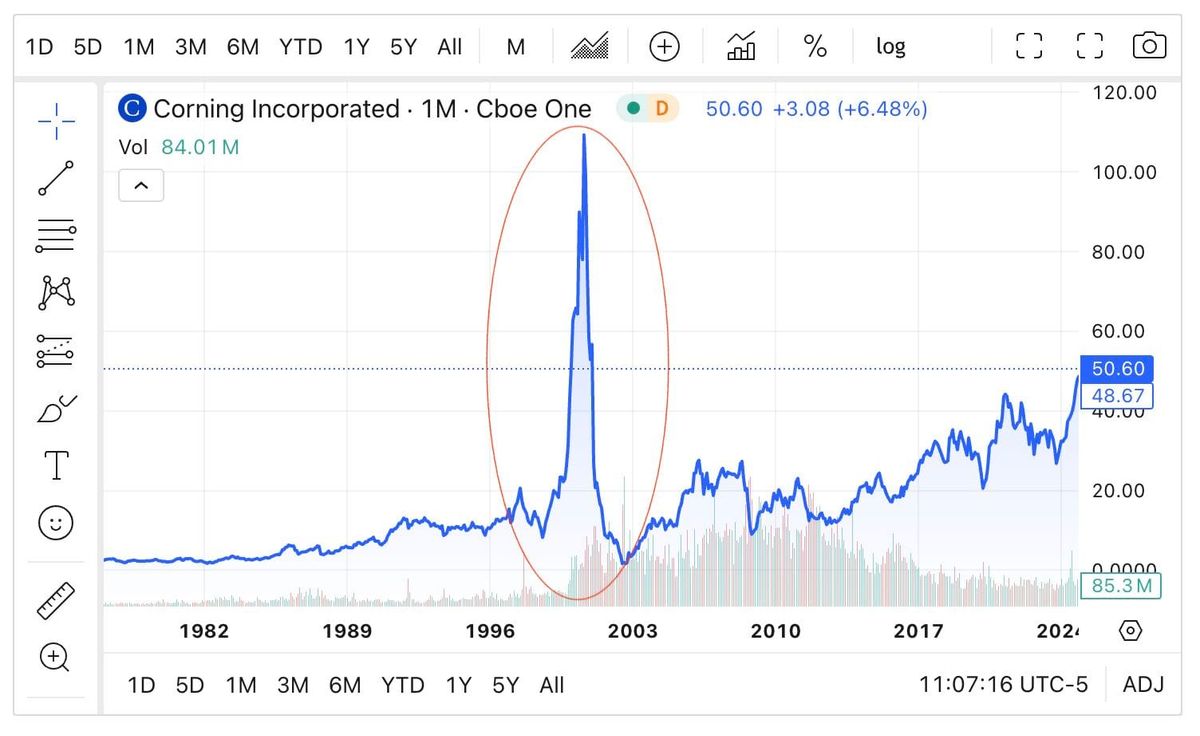
The excitement was palpable in the stock market. Corning, the leading manufacturer of optical fiber, saw its stock price soar by an astounding 15X over just three years.
But then, a technology called Dense Wavelength Division Multiplexing evolved rapidly. It made carrying traffic on optical fiber 40 times more efficient: a single optical fiber could now carry 100 Gbps by sending multiple colors of light through the same fiber. Combined with other advances such as denser strands and new IP standards, it dramatically reduced the need for optical fiber.
This led to a massive glut: 'dark fiber' that had been laid out, but not lit up.
The impact was seismic. Even as internet traffic continued to grow rapidly, much of the optical fiber already laid became redundant, and the sales of optical fiber crashed.
Corning saw its annual revenues plummet by 62% from 2000 to 2002, and its stock price nosedived by 95%. To this day, Corning's stock price has not regained its 1999 peak, while internet traffic today is many orders of magnitude higher.
The glut of fiber laid out in the late nineties took a decade to be utilized. The industry over-invested into the infrastructure layers too quickly, without fully accounting for potential efficiency gains.
While there were other factors at play, including the over-estimation of demand growth and the dot-com bubble bursting, transmission efficiency rising quickly played an important role in this dramatic change of trajectory for the optical fiber industry.
Most of the value from the emergence of the internet was eventually appropriated by app layer companies such as Amazon, eBay and Google, and later by hundreds of Enterprise SaaS companies.
Does the optical fiber buildout of the nineties have parallels with AI datacenter buildouts today? It rhymes - a groundbreaking technology with rapid growth, enabling stocks that skyrocketed, hundreds of billions in infra buildout, and then an efficient new technology arrives..
Will the datacenter buildouts today meet the same fate as the optical fiber buildouts of the 90s, and are GPUs the optical fiber of this generation?
Or will AI inferencing demand - with Jevons paradox - outpace the buildouts in spite of significant efficiency gains in the models?
I don’t know if there is anyone who can say with certainty at this point of time. This game will be played in the arena.