Why Enterprise AI Needs Agent Swarms, Not Just Better Agents
Near-term enterprise value, especially for complex work, will likely come from semi-centralized, swarm-inspired systems: agent swarms with supervision, evals, and agentic + human org charts.
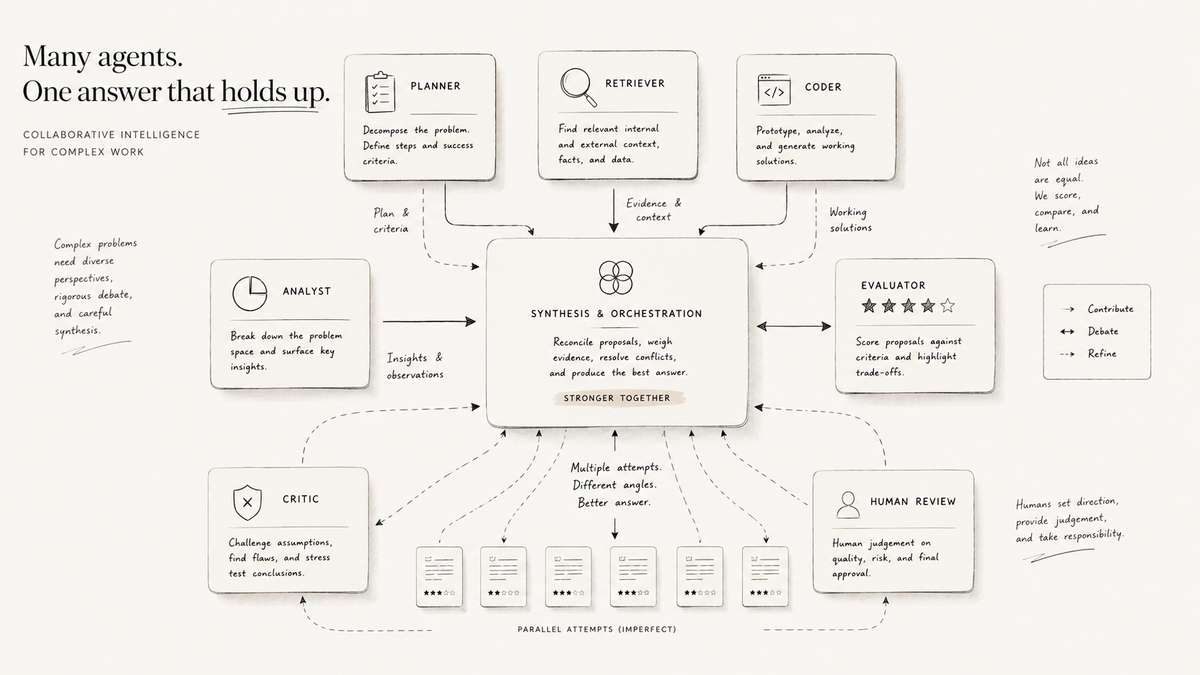
Hard problems aren’t solved by individual brilliance alone. They’re solved by teams and synthesis. AI is catching up.
Moltbook’s recent rise got me thinking about complex problem-solving in Enterprise AI.
When you put together many even modestly capable agents, give them a shared objective, and let them work independently, output quality jumps.
One layer of multi-agent systems has already emerged: specialized agents for different tasks. A planner. A coder. A retriever. An evaluator. Often built on different models or frameworks, each optimized for its role.
The real frontier now is within a single task 🤔
Imagine multiple instantiations of the same agent, same architecture, but different random seeds or calls to different models of similar quality. Each one reasons differently, gets stuck differently, notices different edges. Then an aggregation layer (orchestrator / supervisor) compares, debates, scores, reconciles outputs.
Layer in adversarial agents whose job is to break assumptions. Add eval agents that don’t produce answers, but grade confidence, coverage, and failure modes. And crucially, add a human into the loop, reviewing, approving, and steering when needed.
Many enterprise problems aren’t hard because the core task is complex. They’re hard because the surface area is jagged: messy data, partial truth, long tail exceptions, ambiguous incentives, and no clean ground truth.
This approach echoes how research and innovation in the scientific world works today. It also parallels a deeper transition in AI itself. We’re moving from pre-training scaling laws (more data, bigger models) to inference scaling laws. More reasoning-time compute. More attempts. More parallelism.
Diversity of error is a feature, not a bug. Ensembles in classical ML, stochastic search in optimization, and self-consistency and best-of-N in LLMs all show the same thing: multiple imperfect attempts, aggregated well, outperform a single “smart” one on complex problems.
There is extensive prior art for multi-agent systems in enterprise decisioning, operations, and automation. Think fraud detection stacks or cybersecurity systems that run multiple independent risk scorers on the same event.
What’s new is not the idea of parallel workers, but the fact that AI models now allow them to reason flexibly, coordinate cheaply, and plug directly into human review loops. And because these models are inherently stochastic, running them in parallel naturally explores multiple reasoning paths, making this approach potentially applicable to a wider class of messy, real-world problems.
This feels like an intermediate step toward swarm AI, where agents coordinate with each other rather than being centrally orchestrated.
Near-term enterprise value, especially for complex work, will likely come from semi-centralized, swarm-inspired systems: agent swarms with supervision, evals, and agentic + human org charts.